Quick answer: Road Trip mushroom gummies are built around a proprietary blend the brand calls Seronoesin, combined with functional mushrooms like Lion’s Mane, Reishi, and Cordyceps, in a gummy base of pectin, sugar, tapioca syrup, citric acid, and natural flavors. Many retailers also describe the active as Amanita muscaria extract, whose compounds are muscimol, ibotenic acid, and muscarine. The brand states the gummies contain no psilocybin, THC, HHC, or CBD. The honest catch is that the exact active and its per-gummy dose are not fully disclosed, and descriptions differ between the brand and its sellers. Here’s the full picture. Adults 21 and up only.
If you’ve searched “what is in Road Trip mushroom gummies,” you’ve stumbled onto a question that’s genuinely harder to answer than it should be, and that’s worth knowing before anything else. Road Trip is one of the most searched legal mushroom gummy brands online, but the honest truth is that what’s listed as the active ingredient changes depending on whether you read the brand’s own website or a third-party shop’s product page. This article lays out everything that’s actually disclosed, what’s deliberately kept vague, and what independent testing has found in this category, so you can make an informed call.
Let’s start with the most important framing. Road Trip gummies are sold as legal, psilocybin-free products. They are not classic magic mushrooms. But “psilocybin-free” doesn’t mean “simple,” and the ingredient list has more moving parts than the candy-style packaging suggests.
The short answer: what’s in Road Trip mushroom gummies
Pulling together the brand’s disclosures and the most detailed retailer labels, here is the fullest picture of what goes into a Road Trip gummy:
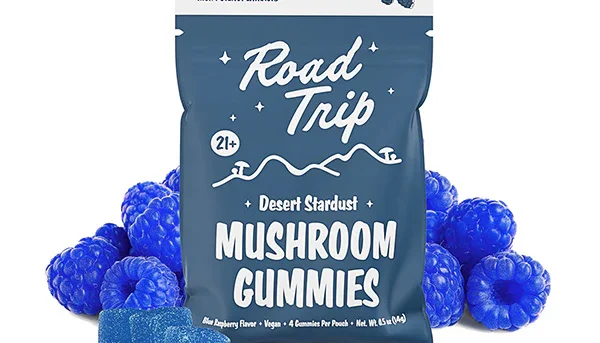
- A proprietary active blend. The brand’s own site centers the formula on a trademarked ingredient it calls Seronoesin, describing it as a proprietary, plant-inspired blend. The amount varies by product line, listed as 3mg per gummy in the full-strength Desert Stardust and Motel Magic, 1.71mg in Happy Caps, and 1.2mg in the microdose gummies.
- Amanita muscaria extract. Many third-party retailers describe the active as Amanita muscaria, the red-and-white “fly agaric” mushroom. Its naturally occurring compounds are muscimol, ibotenic acid, and muscarine, which is what some labels list as the active ingredients.
- Functional mushrooms. Depending on the specific product, the blend includes functional (non-psychoactive) mushrooms such as Lion’s Mane for clarity, Reishi for relaxation, Cordyceps for energy, and in some versions Chaga and Turkey Tail.
- The gummy base. The inactive ingredients are typical gummy components: pectin, sugar, tapioca syrup, citric acid, sodium citrate, and natural colors and flavors. Flavors have included Raspberry, Peach, and Watermelon. The gummies are marketed as vegan and non-GMO.
So the simplest honest answer is: a proprietary active blend (named as Seronoesin by the brand, and as Amanita muscaria by many sellers), plus functional mushrooms, in a standard fruit-flavored gummy base. The complications, which matter, come next.
Here’s a visual look at the product before we dig into the details:
The Seronoesin question: what is the active really?
Here’s where the answer gets genuinely murky, and where an honest article has to slow down. Road Trip’s own website frames the active as Seronoesin, a trademarked proprietary blend it describes as plant-inspired, and it states clearly that its products do not contain psilocybin, psilocin, 4-AcO-DMT, THC, HHC, or CBD. The brand even says it keeps these formulas deliberately separate from hemp and cannabis compounds so customers know what they’re choosing.
But many of the retailers that sell Road Trip describe the exact same gummies as Amanita muscaria products, listing muscimol, ibotenic acid, and muscarine as the active ingredients, with eye-catching potency claims like 3500mg of nano-amplified Amanita extract per gummy. And confusingly, in at least one place the brand describes its own Desert Stardust line as a proprietary blend of tryptamines meant to mimic the effects of psilocybin, which doesn’t square neatly with the “just a plant-inspired blend” framing elsewhere.
What does this mean for you as a buyer? It means that despite the long ingredient discussions, the precise identity and dose of the psychoactive component is not fully transparent. You cannot reliably tell from the public information exactly how much muscimol, ibotenic acid, or any other active compound is in a single gummy. That opacity is the single most important thing to understand about this product’s ingredients.
What Road Trip gummies do NOT contain
The brand is clearer about exclusions than inclusions, and these are worth stating plainly because they’re a real part of the appeal:
- No psilocybin or psilocin. These are the compounds in classic magic mushrooms, and they remain federally illegal. Road Trip states its products don’t contain them.
- No 4-AcO-DMT. A synthetic psilocybin analog, also excluded per the brand.
- No THC, HHC, or CBD. Unlike some competing mushroom edibles that add hemp cannabinoids, Road Trip says it keeps cannabinoids out entirely, and third-party tests cited by retailers report non-detectable THC, under 0.01%.
Because of those exclusions, the brand notes that standard drug panels (5, 8, 10, and 12-panel) generally screen for substances like THC and opiates rather than functional mushrooms or its proprietary blend. Still, if you face testing, verify with the specific product’s lab report rather than relying on marketing copy.
The most important safety context: what independent testing has found
This is the part that matters most for anyone asking what’s really in these products, and it’s not specific to Road Trip, but it applies directly to the entire category of mushroom “nootropic” gummies.
In 2024, the CDC published a report on mushroom nootropic gummies after several people, including a child, were hospitalized in Virginia. Investigators tested gummies labeled to contain Amanita muscaria or proprietary mushroom blends. The findings were striking: several of the tested products contained unlabeled Schedule I substances, specifically psilocybin and psilocin, despite not listing them. Some also contained other undisclosed substances including caffeine, ephedrine, and mitragynine, the active compound in kratom. Just as notably, in some gummies the muscimol, ibotenic acid, and muscarine that the labels claimed were not even detected.
The lesson here is direct. In this category, the label does not always match the contents, in either direction. That is precisely why the proprietary-blend opacity around products like Road Trip matters, and why buying from an accountable, lab-transparent retailer that publishes a current certificate of analysis is the single best protection you have. A batch-specific lab report is the only way to know what’s actually in the gummy in your hand.
Separately, what the FDA has said about Amanita
There’s one more piece of regulatory context relevant to the ingredients. Amanita muscaria is not a federally scheduled substance, which is why products built on it can be sold legally in most states (Louisiana being a notable exception). However, the FDA has stated that Amanita muscaria and its constituents do not meet the “Generally Recognized as Safe” standard for use in food. That places Amanita-based edibles, including those that describe themselves this way, in a regulatory gray area worth knowing about.
Ingredient summary at a glance
| Component | What it is | Disclosed clearly? |
|---|---|---|
| Seronoesin blend | Brand’s trademarked proprietary active | Named, but contents not detailed |
| Amanita muscaria | Muscimol, ibotenic acid, muscarine | Listed by sellers, not always by brand |
| Functional mushrooms | Lion’s Mane, Reishi, Cordyceps, more | Named, doses not given |
| Gummy base | Pectin, sugar, tapioca syrup, flavors | Yes |
| Excluded | No psilocybin, THC, HHC, CBD per brand | Stated, verify via COA |
How to actually verify what’s in your gummies
Since the label and the contents don’t always agree in this category, here’s the practical checklist for confirming what you’re getting:
- Find the batch-specific lab report. Look for a certificate of analysis whose lot number matches your package, not a generic QR code. This is the most reliable signal of what’s inside.
- Buy from an accountable shop. A retailer that publishes COAs and can answer questions beats an anonymous marketplace listing. This is your best protection given the category’s testing history.
- Read the exclusions and the actives. Confirm what the product says it does and doesn’t contain, and treat vague “proprietary blend” language with no active named as a reason to ask more.
- Start very low. Because potency isn’t precisely labeled and nano-amplification can make a single gummy hit harder than expected, begin with a fraction of one and wait the full onset.
Where to find lab-tested mushroom products
If you want mushroom products from a shop that publishes lab reports and can explain exactly what each one contains, deVINE Boston is a solid example. It’s a South Boston wellness shop, founded in 2019, that curates a lab-tested selection of legal, psilocybin-free mushroom products and posts third-party lab reports for what it carries, including its Road Trip mushroom gummies listing. You can ask staff to walk you through what’s actually in a given product and read the documentation before buying. If you’d prefer a more clearly labeled option, browse the full legal mushroom collection to compare against products like the Rize line, which states gram counts more plainly. The shop is at 619 E Broadway, open 10am to 10pm daily, with free Greater Boston shipping over $65. Specific brands sell out periodically, so check current availability. It’s 21+ only.
Visit deVINE Boston
If you’d rather see the products in person and ask exactly what’s in each one, deVINE is at 619 E Broadway in South Boston, open 10am to 10pm seven days a week.
Frequently asked questions
What is the active ingredient in Road Trip mushroom gummies?
The brand names it as Seronoesin, a trademarked proprietary blend, while many retailers describe the active as Amanita muscaria extract (with muscimol, ibotenic acid, and muscarine). The exact identity and per-gummy dose are not fully disclosed, which is the main transparency issue with the product.
Do Road Trip gummies contain psilocybin?
The brand states they contain no psilocybin, psilocin, or 4-AcO-DMT. Be aware, though, that a 2024 CDC report found some mushroom nootropic gummies in this broader category did contain unlabeled psilocybin, so buying from a lab-transparent retailer and checking the COA matters.
Do they contain THC or CBD?
No. Road Trip states its formulas have no THC, HHC, or CBD, and third-party tests cited by sellers report non-detectable THC under 0.01%. If you face drug testing, confirm with the specific product’s lab report.
What are the inactive ingredients?
The gummy base typically includes pectin, sugar, tapioca syrup, citric acid, sodium citrate, and natural colors and flavors, in fruit flavors like Raspberry, Peach, and Watermelon. The gummies are marketed as vegan and non-GMO.
Are Road Trip mushroom gummies legal?
They’re sold as legal, psilocybin-free products, and Amanita muscaria is legal in most states (Louisiana is a notable exception). That said, the FDA has stated Amanita compounds don’t meet the food-safety GRAS standard, so the category sits in a gray area. Check your local laws.
How can I know exactly what’s in the gummy I buy?
Find the batch-specific certificate of analysis that matches your package’s lot number, and buy from an accountable shop that publishes lab reports. Given that label and contents don’t always match in this category, the COA is the only reliable way to verify.
Disclaimer: This article is for informational and research purposes only and is not medical or legal advice. Products discussed are intended for adults 21 and older and are sold as psilocybin-free where noted. Legal status varies by state and locality; verify the rules where you live before purchasing. These statements have not been evaluated by the FDA, and these products are not intended to diagnose, treat, cure, or prevent any disease. Independent testing has found that some products in this category contain undisclosed ingredients; buy only from lab-transparent sellers and check the certificate of analysis. Do not use if pregnant or nursing, and consult a licensed medical practitioner before use if you take medication or have a medical condition. Keep out of reach of children and pets.